The unmanned aerial vehicle industry also known as drones, has experienced explosive growth over the past decade, with applications spanning from recreational first-person view (FPV) racing to critical industrial operations. At the heart of this revolution lies a persistent challenge: establishing reliable, long-range communication between ground stations and drones while maintaining low power consumption and manageable costs. Enter LoRa® technology, a game-changing wireless communication protocol that's transforming how drones communicate with their operators and with each other.
Originally developed by Semtech Corporation, LoRa uses Chirp Spread Spectrum (CSS) modulation to enable over 10 kilometers of long-range wireless communication while consuming minimal power. This unique combination of characteristics makes it ideal for drone applications where battery life, weight constraints and reliable connectivity are paramount concerns. As the drone industry continues to mature, LoRa has emerged as one of the most promising communication technologies, challenging traditional radio control (RC) links and enabling entirely new applications.
How LoRa Systems Are Being Used In Drones
1. Drone Remote Control and Telemetry
The most fundamental application of LoRa in drones is remote control communications between the ground transmitter and airborne receiver. Unlike traditional radio systems that can struggle beyond a few hundred meters, LoRa-based systems routinely achieve a 5–10-kilometer range, with some configurations extending beyond 30 kilometers with protocols like Express Long-Range System (ELRS). This extended range opens possibilities for long-range exploration, industrial inspections, and search-and-rescue operations that were previously impractical.
LoRa systems provide bidirectional communication, enabling pilots to send control commands to the drone while simultaneously receiving critical telemetry data including battery voltage, GPS coordinates, signal strength, and link quality metrics. This two-way data flow is essential for informed decision-making during flight operations.
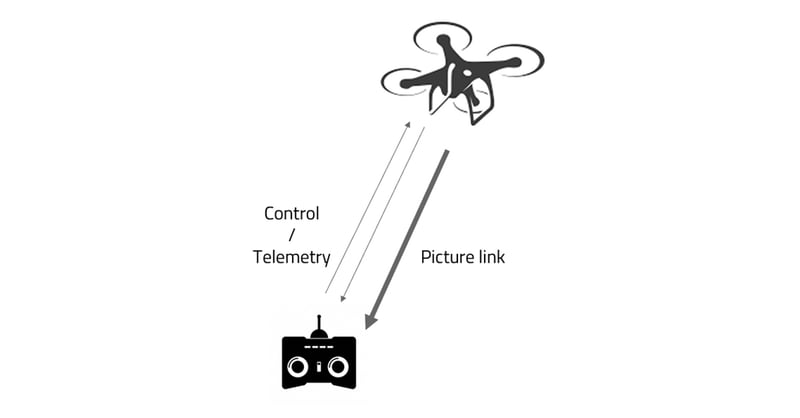
Remote control equipped with LoRa transmitting and receiving the signals from the drone equipped with LoRa
2. Autonomous LoRa Drone Operations
In autonomous systems, LoRa serves as the communication backbone for transmitting mission commands and waypoints from ground control stations to onboard flight controllers. By integrating LoRa with MAVLink protocol (a lightweight messaging protocol for communication with drones and ground control stations), operators can send complex mission plans, adjust flight parameters dynamically and maintain situational awareness throughout autonomous flights. This integration supports applications such as agricultural surveying, infrastructure inspection and environmental monitoring.
Protocols Built on LoRa for Drone Control
While LoRa defines the physical layer of communication, several protocols like ExpressLRS build on this foundation to provide a complete control system for drones.
Express Long-Range System (ELRS): The Open-Source Revolution
ExpressLRS has emerged as the de facto standard for open-source drone control links, fundamentally disrupting the previously proprietary-dominated market. Launched in 2018, this community-driven project has rapidly evolved to become arguably the best RC link available for FPV drones and other radio-controlled vehicles.
Technical Capabilities:
ExpressLRS supports dual-band operation on 900MHz bands (868/915MHz Industrial, Scientific and Medical (ISM) bands) and 2.4GHz frequencies, giving pilots flexibility to choose the optimal frequency for their flying environment. The 900MHz variants prioritize maximum range and penetration. The 2.4GHz versions leverage FLRC (Fast Long-Range Communication) and LoRa modulation to deliver high data rates with minimal latency, making them ideal for competitive racing and image transfers during beyond-visual-line-of-sight (BVLOS) operations.
Key Features:
- Multiple packet rates: From 50Hz for extreme long-range operations to 1000Hz for ultra-low latency racing.
- Frequency hopping spread spectrum (FHSS): Mitigates interference and improves reliability.
- Dual antenna systems: "Gemini" mode uses two antennas simultaneously on different frequencies for enhanced link stability, while "GeminiX" extends this concept to dual-band operation (2.4GHz + 900MHz simultaneously).
- Dynamic power control: Automatically adjusts transmission power based on link quality.
The Hardware Ecosystem:
ExpressLRS runs on Semtech's LoRa hardware (primarily SX127x for sub-GHz and SX1280 for 2.4 GHz, with newer implementations using SX1262, LR1121, LR2021) paired with ESP32, ESP8285 or STM32 microcontrollers. The protocol uses the Crossfire Serial Protocol (CRSF) for communication between receivers and flight controllers, ensuring compatibility with popular firmware like Betaflight, iNav and ArduPilot.
Hundreds of hardware manufacturers now produce ExpressLRS-compatible equipment, from tiny sub-gram receivers for micro drones to high-power transmitter modules capable of reaching extreme distances. This thriving ecosystem provides choices for every budget and application.
Why Semtech LoRa ICs are the Favorite for ELRS
As the company behind LoRa, Semtech has industry-leading expertise in modulation technology. The modulation technique operates up to -20dB below noise and interference and reaches extreme distances with link budgets exceeding 160dB with 100mW Tx.
The drone community selected the LoRa technology for these key performance advantages:
- High sensitivity without a precision clock: Unlike narrowband systems that require tight TX–RX frequency alignment (higher cost), LoRa achieves high sensitivity with relaxed clock accuracy
- Strong interference tolerance: Spread spectrum signaling ensures partial signal loss degrades sensitivity gracefully without necessarily causing data loss
- Constant-envelope transmission: Enables highly efficient RF power amplifier operation
- Flexible data rates within the same bandwidth: Allows consistent channel planning while trading data rates for link budget
- Proven ecosystem adoption: LoRa Gen1 (SX1276) was the first LoRa radio adopted by ExpressLRS followed by SX1272 and LR1121
- Next-generation evolution – LoRa Gen4 (LR2021)
- Single PA efficient across +14dBm to +22dBm
- Single-SKU Multi-Regional
- 2x sub-GHz LoRa throughput of Gen 3 (125 kbps)
- 2.6 Mbps Max data rate with FLRC
- Supports 1MHz LoRa BW
- Multi-band support
- Superior performance for drone control and telemetry
Why ExpressLRS Built on Top of LoRa Dominates
- Performance: ExpressLRS consistently outperforms proprietary alternatives in both latency and range benchmarks.
- Cost: Complete transmitter and receiver packages cost less than equivalent proprietary systems.
- Community support: Active Discord channels, extensive documentation, and continuous firmware improvements drive rapid innovation.
- Binding simplicity: The "binding phrase" system works like a Wi-Fi password, eliminating tedious physical button-pressing rituals.
- Transparency: Open-source nature enables auditing, customization, and confidence in long-term support.
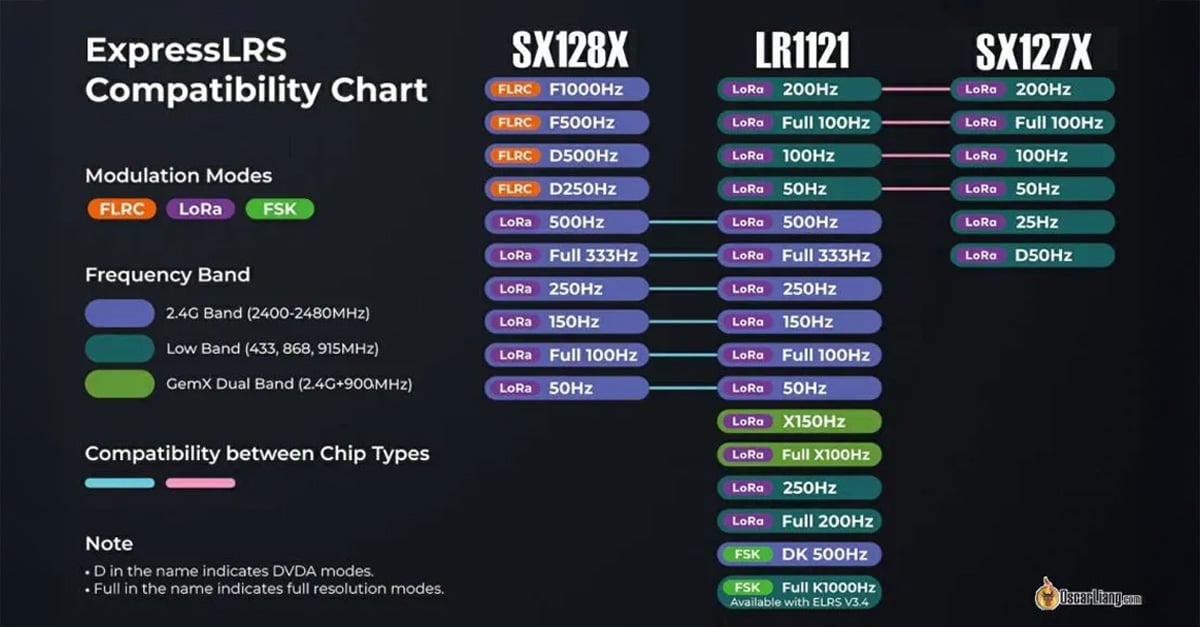 Credits: Oscar Liang
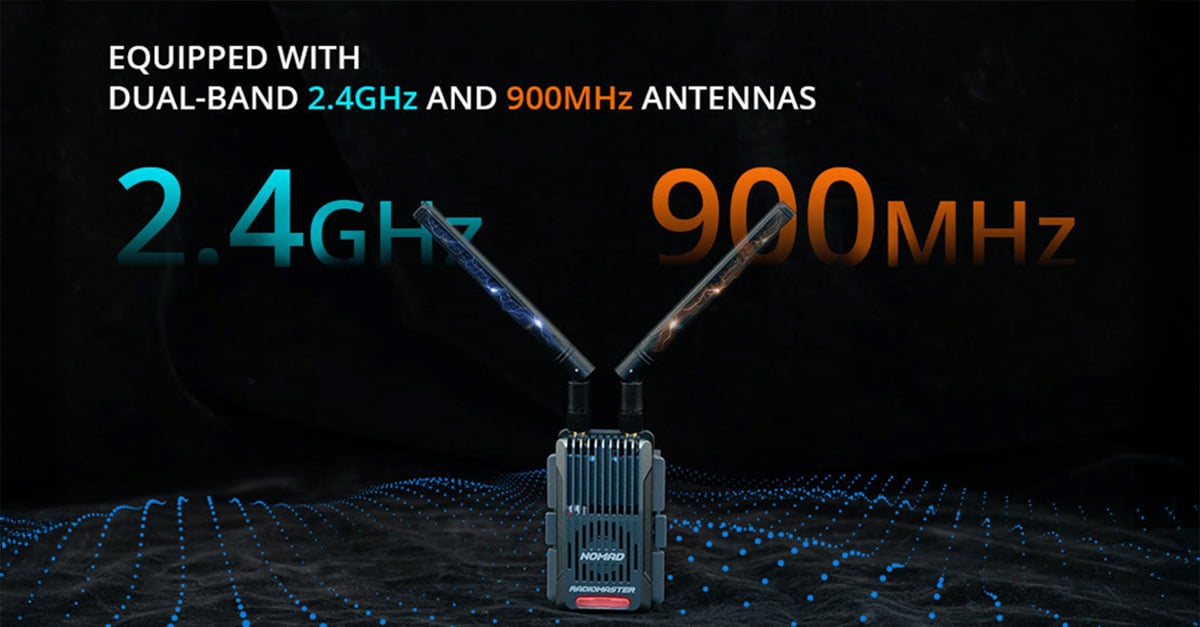
Radio Master 'Nomad' RF communication module made with LoRa
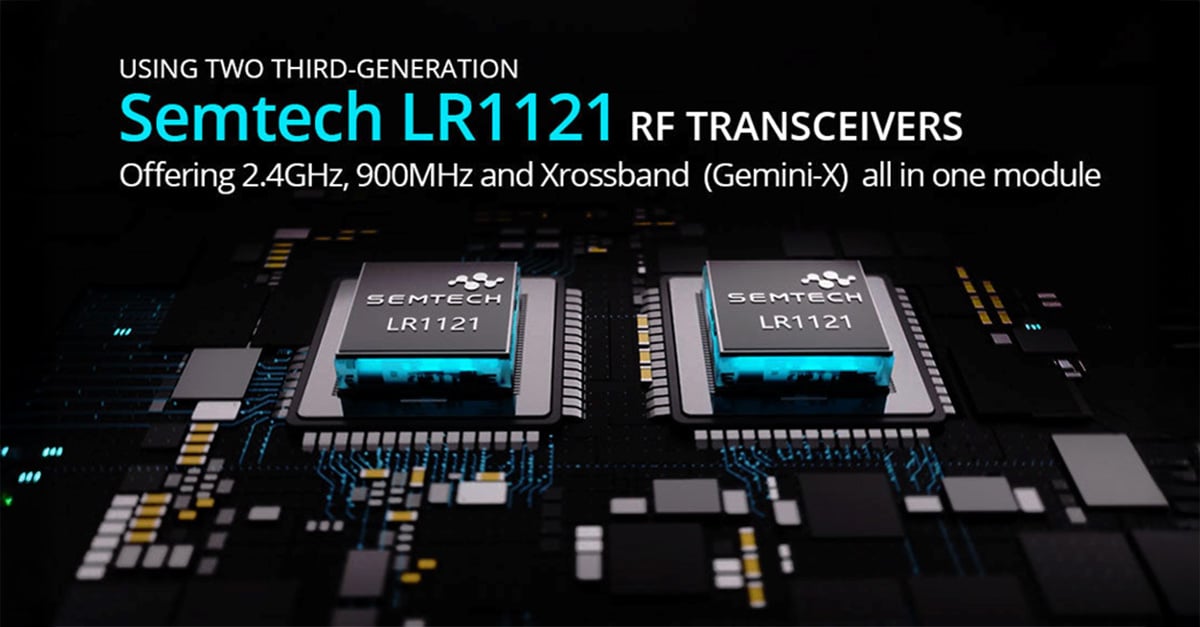
RadioMaster Nomad RF communication module built using two LR1121s for dual-band operation
Other LoRa-Based Control Protocols
Beyond ExpressLRS, several other protocols deserve mention:
- mLRS: mLRS project offers an open source 2.4GHz & 915/868MHz & 433MHz/70 cm LoRa-based high-performance long-range radio link, which provides bidirectional serial connection combined with full remote control
- TBS Crossfire: A pioneering commercial LoRa-based system that helped prove the concept, though it uses LoRa modulation only at 50Hz (switching to FSK at 150Hz)
- FrSky R9: A commercial alternative that hasn't achieved the same market penetration as ExpressLRS
- Custom implementations: Various research projects and specialized applications have developed proprietary LoRa protocols optimized for specific use cases
LoRa in FPV/RC Drones and Autonomous Drones
LoRa technology serves both manually controlled and autonomous drones, but the implementation details and priorities differ significantly between these applications.
FPV and RC Drone Applications
For first-person view and recreational drone pilots, latency and update rate are paramount concerns. Racing pilots require immediate control response, making FLRC mode the preferred choice despite its reduced range compared to traditional LoRa modulation. These applications prioritize:
- Ultra-low latency: Sub-10ms control latency enables competitive racing and precise freestyle maneuvers.
- High update rates: 250-500Hz represents the sweet spot for most freestyle flying, balancing responsiveness with reasonable range.
- Minimal setup complexity: Consumer-friendly interfaces and straightforward binding procedures.
- Compact hardware: Lightweight receivers that don't compromise performance on small, agile aircraft.
ExpressLRS has become the weapon of choice for FPV pilots, appearing as standard equipment on many ready-to-fly drones and available as retrofit kits for virtually any existing drone. The combination of performance, cost and ease of use has made it ubiquitous in the FPV community.
Autonomous Drone Applications
Autonomous operations present different priorities and constraints:
Communication Architecture: Autonomous drones typically use LoRa for command-and-control messaging rather than continuous stick input streaming. Ground control stations send mission waypoints, parameter updates and mode changes, while drones report position, status and sensor data. This lower-bandwidth, higher-latency tolerance application is perfectly suited to LoRa's characteristics.
MAVLink Integration: The MAVLink protocol has become the standard for autonomous drone communication, and LoRa provides an excellent physical layer for transmitting MAVLink messages. LoRa/MAVLink integration enables reliable control of autonomous flights over extended distances.
Range Over Speed: Autonomous missions such as agricultural surveys, pipeline inspections and environmental monitoring prioritize extended range and reliability over instantaneous response. Operators can accept 50-100ms latency when sending waypoint updates or mode changes, enabling the use of lower update rates (50-100Hz) that dramatically extend range.
Mesh Networking: Autonomous drone swarms benefit from LoRa's potential for creating flying mesh networks. Multiple drones can relay information between ground stations and distant aircraft, extending effective coverage and providing redundancy.
Energy Efficiency: Long-endurance autonomous missions place premium value on power efficiency. LoRa's low power consumption helps preserve battery capacity for flight time rather than communication overhead.
Hybrid Systems: Some autonomous platforms employ dual-band configurations, using 2.4GHz LoRa or FLRC for local, responsive control when needed, while maintaining a 900MHz LoRa link for extended-range telemetry and command updates.
The Future of LoRa in Drones
The drone industry's trajectory points toward increasingly sophisticated applications that will further leverage LoRa's strengths. Several trends are emerging:
- Satellite integration: Semtech's LR1121 chip adds S-band satellite connectivity alongside terrestrial LoRa, enabling truly global drone operations beyond cellular and terrestrial gateway coverage.
- Advanced modulation schemes: Continued research into optimizing physical layer protocols may yield higher data rates while maintaining LoRa's range advantages.
- AI-enhanced operations: Machine learning algorithms can optimize spreading factors, power levels and frequency selection in real-time based on link conditions and mission requirements.
- Regulatory maturity: As aviation authorities develop frameworks for beyond-visual-line-of-sight (BVLOS) operations, reliable long-range communication systems like LoRa will become essential compliance tools.
- Commercial adoption: Beyond hobbyist and research applications, commercial drone operators are increasingly recognizing LoRa's value for inspection, surveying, and delivery operations.
- Gateway and Data Collection Roles: Autonomous drones equipped with LoRa gateways serve as flying data collectors for ground-based sensor networks. These applications leverage LoRa's excellent penetration and range to gather environmental data, monitor livestock or survey infrastructure across wide areas that would require dozens of fixed gateways to cover. They can also operate offline, storing data when connectivity is unavailable and uploading it to the cloud once reconnected.
LoRa technology has fundamentally transformed drone communications, democratizing long-range capabilities that were once the exclusive domain of expensive proprietary systems. From enabling FPV pilots to explore beyond the horizon to supporting autonomous agricultural monitoring across vast farmlands, LoRa's combination of range, power efficiency and cost-effectiveness addresses the core communication challenges facing the drone industry.
The success of open-source projects like ExpressLRS demonstrates the power of community-driven innovation, while research into gateway applications continues to expand LoRa's applicability. As Semtech introduces new hardware like the LR1121 with multi-band and satellite capabilities, the technology potential continues to grow.
For drone operators, manufacturers and system integrators, LoRa represents not just an incremental improvement, but a paradigm shift making previously impossible missions routine and opening entirely new categories of applications. Whether controlling a racing quad at 1000Hz or coordinating an autonomous agricultural survey across dozens of square kilometers, LoRa has proven itself as the connectivity backbone for the next generation of unmanned aviation.
Ready to integrate LoRa technology into your drone platform? Explore Semtech's comprehensive portfolio of LoRa-enabled chips and development resources, or contact our team to discuss how LoRa can extend your operational capabilities.
Semtech, the Semtech logo, and LoRa® are registered trademarks or service marks of Semtech Corporation or its affiliates. Other product or service names mentioned herein may be the trademarks of their respective owners.